HubSpot CRM Governance

A governed CRM system for ownership, qualification, and follow-up.

This portfolio project shows how JITAI Systems designed a controlled HubSpot operating model for CRM governance, contact review, task creation, workflow safety, and evidence-based execution.

Executive summary

Automation was the last step, not the first.

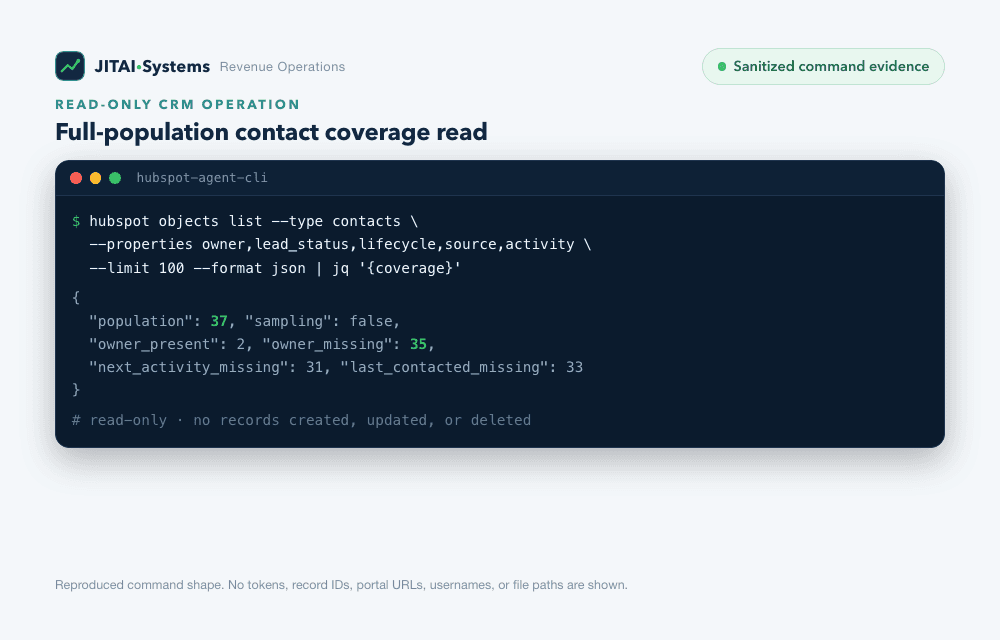
A read-only audit of the full contact population showed that records existed but the operating layer did not: most contacts had no owner, no scheduled next step, and no logged outreach. Adding automation on top of that foundation would have scaled the gaps instead of closing them.

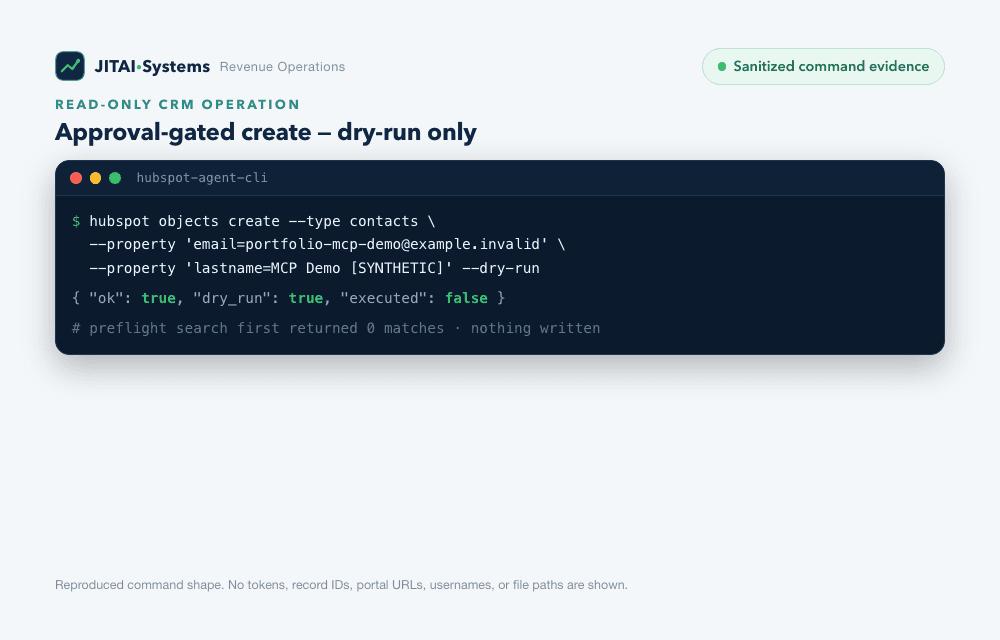
So the project deliberately avoided uncontrolled automation. It defines who owns a record, what its review status is, and what single task should exist at any moment. Task creation is idempotent, status changes stay in human hands, and every proposed CRM write is inspected, dry-run, and approval-gated before anything executes. The result is a CRM operating model a small team can trust and audit.

Verified audit findings

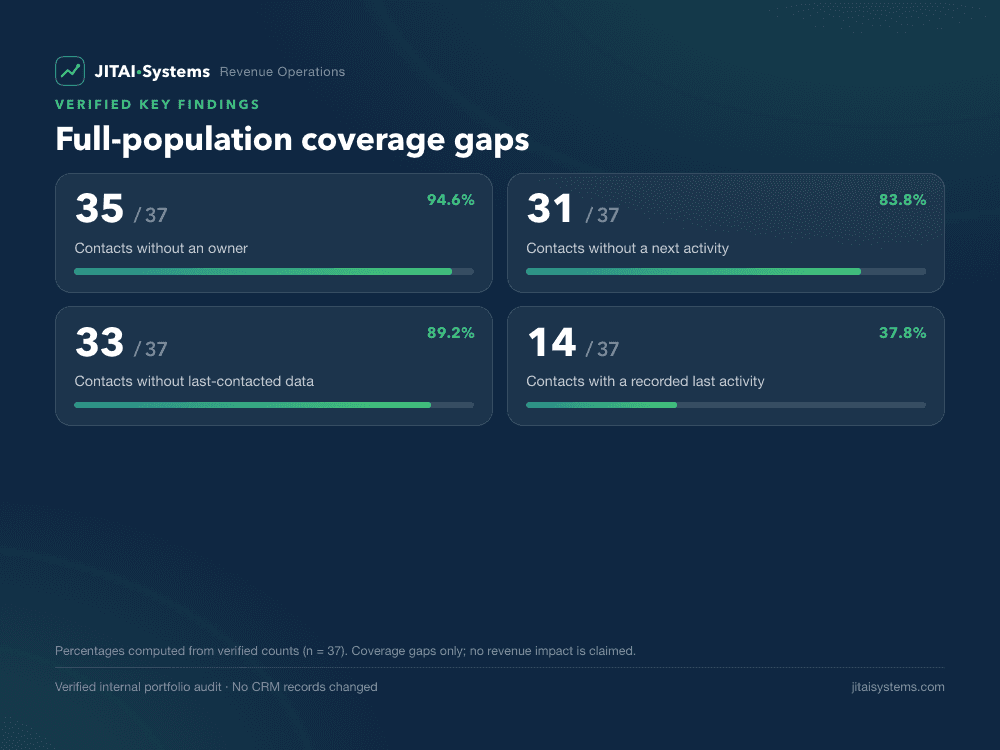
  • 35 of 37 contacts had no assigned owner (94.6%).
  • 31 of 37 contacts had no scheduled next activity (83.8%).
  • 33 of 37 contacts had no recorded last-contacted value (89.2%).
  • 37 of 37 populated lead statuses were NEW and every source was OFFLINE.

Full population, no sampling. Counts reconciled through two independent read paths. No revenue impact is claimed.
System architecture

Status gates everything. Nothing moves without one.

HubSpot CRM Governance and Revenue Operations SystemIllustrative system architecture

Contact intake

A contact exists in the CRM with whatever data arrived with it.

Governance status

Every contact carries an explicit review status that gates all downstream behavior.

Owner assignment

Ownership is assigned before follow-up work is created, and an existing owner is never overwritten.

Task creation

One follow-up task per eligible cycle, guarded by an idempotency flag on the contact.

Reset and re-enrollment

A separate reset path clears the task flag so a contact can re-enter the cycle deliberately, never accidentally.

Exception

Records that fail data or eligibility rules queue for human review instead of silently proceeding.

Evidence

Every proposed change is inspected, dry-run, and logged so the system stays auditable.

Control Exception Output

Governance model

Six statuses control review and workflow behavior.

Statuses decide what the system may do with a record. They gate review queues and workflow eligibility without ever sending uncontrolled communications.

Active Follow-Up

The contact is owned and in a live follow-up cycle with a due task.

Needs Qualification

The contact requires human review before any follow-up work is created.

Dormant

No recent activity. The contact is parked and excluded from active cycles until deliberately re-enrolled.

Invalid or Incomplete

The record is missing data that routing depends on. It queues for cleanup, not automation.

Excluded

Deliberately outside the governed cycle. Nothing is created for these records.

Remediated

Reviewed and corrected. The record carries its history and can re-enter a cycle under the normal rules.

Workflow controls

Two workflows, one contract: no surprises.

The design uses a deliberately small two-workflow pattern. The primary workflow, Active Follow-Up Ownership, assigns ownership and creates the single follow-up task for eligible contacts. The reset workflow, Reset Active Follow-Up Task Flag, clears the idempotency flag so a contact can re-enter the cycle only when that is the explicit intent.

Both workflows are designed against a fixed contract of things they will never do.

Designed guarantees

  • One task maximum per eligible cycle, enforced by the idempotency flag.
  • An existing owner is never overwritten.
  • No deal is created.
  • No email is sent.
  • No sequence enrollment occurs.
  • Lifecycle stage is never manipulated by the workflows.
  • No hidden external action of any kind.

Evidence

Labeled evidence, nothing borrowed.

Every visual is either a verified aggregate or a clearly labeled sanitized reconstruction. No live portal screenshot appears anywhere in this project.

Metric cards showing verified audit coverage gaps: 35 of 37 contacts without an owner, 31 of 37 without a next activity, 33 of 37 without last-contacted data, and 14 of 37 with a recorded last activity.
Verified aggregate findings from the read-only audit. Percentages are computed from the full 37-contact population.
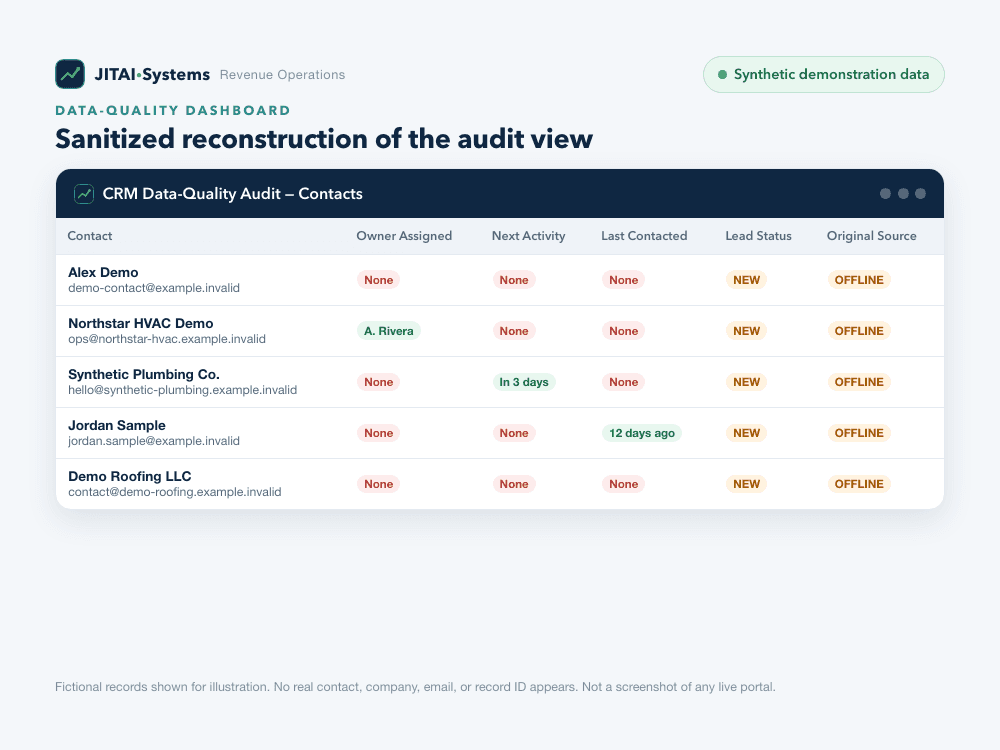
Sanitized reconstruction of a CRM data-quality audit table with fictional contacts such as Alex Demo and Synthetic Plumbing Co., labeled as synthetic demonstration data.
Sanitized reconstruction of the audit view. Every row is synthetic demonstration data; no real contact, company, email, or record ID appears.
Sanitized terminal card showing a read-only HubSpot CLI command that returned aggregate coverage counts for 37 contacts with no records created, updated, or deleted.
Sanitized command evidence for the full-population coverage read. No tokens, record IDs, portal URLs, usernames, or file paths are shown.
Sanitized terminal card showing an approval-gated HubSpot contact creation that ran as a dry run only, returning executed false.
The approval-gated write path. The contact creation ran as a dry run only and returned executed: false.

Testing and validation

Each claim carries its actual test state.

Nothing below is collapsed into a single working label. Each area is reported at the level it has genuinely reached.

Verified

  • Read-only audit of the full 37-contact population, reconciled two independent ways.
  • Aggregate coverage findings (ownership, next activity, last contacted, lead status, source).
  • Zero CRM records created, updated, merged, or deleted during the audit.

Pinned synthetic

  • The demonstration contact and task use reserved synthetic identities on a non-routable .invalid email domain.
  • The contact-creation dry run completed and returned dry_run: true, executed: false.

Authenticated only

  • MCP and CLI identity verification succeeded against the portal, exercised no further than read scope.

Not yet tested

  • Reset and re-enrollment behavior under live workflow execution.
  • Idempotency-flag behavior across repeated enrollment cycles in production.

Planned

  • Deployment of the two-workflow pattern (ownership workflow plus reset workflow) behind per-change approval.
  • Saved governance views: Unowned Contacts, Follow-Up Due This Week, Recently Active with No Owner.

Blocked

  • Workflow-definition inspection: the connected credentials intentionally lack automation scope, so workflow internals could not be read.

My role

AI Integration and Revenue Operations Engineer

Justin Maher designed, built, tested, and documented the system end to end, including the decision about what was safe to release and what stayed gated.

Responsibilities

  • CRM architecture and the governance data model.
  • Workflow governance rules and safe boundaries.
  • Idempotency design for task creation and reset behavior.
  • Safety constraints: read-only defaults, dry runs, and approval gates.
  • Testing, evidence capture, and public-safety redaction.
  • Documentation and the release decision itself.

Technology

Built with the tools already in the stack.

HubSpotn8nAirtableGmailOpenAIAnthropicPerplexity

Tool names are listed for compatibility context only. Trademarks belong to their owners. No partnership, endorsement, or certification is implied.

Limitations

What this project does not claim.

The honest boundary is part of the system. These constraints are deliberate and they are published with the work.

Stated limitations

  • Synthetic portfolio records are used wherever a record-level example appears.
  • No client revenue result is claimed anywhere in this project.
  • Customer communication remained fully controlled; the system sends nothing on its own.
  • The design centers on human approval and auditability rather than autonomous execution.
  • Some production actions remain intentionally disabled until they pass their own approval gate.

Case study

Read the full write-up.

The six-page case study covers the audit scope, verified findings, risk controls, proposed remediation, what was not executed, and the evidence classification for every claim.

Public-safe PDF

HubSpot CRM Governance Case Study

Verified internal portfolio audit. No CRM records were changed and synthetic data is used in all public visuals.

Download the Case Study (PDF)

Fixed-scope next step

Find where your CRM handoffs are breaking.

The CRM Revenue Leak Audit traces ownership, follow-up, stale records, estimates, and workflow gaps across the systems you already use.

justin@jitaisystems.com(978) 551-2922

Request the $1,500 Audit Scope
Get the AuditCall Justin